First days with a puppy at home: how to manage the beginning
March 23, 2026

Katka

Bringing a puppy home is a beautiful moment. At the same time, it is also a big change — for you and for him. Suddenly, there is a new family member at home who does not yet know your rules, the rhythm of the day, or the environment. And during the first few days, you often ask yourself what is normal, what is not, and if you are doing something wrong.
The good news is that uncertainty at the beginning is completely normal. The first days with a puppy do not have to be perfect to be good. The most important thing is to create a safe, calm beginning for him and not to put unnecessary pressure on him or yourself.
In this article, we will look at what to expect on the first trip home, how to handle the first night, how to set up feeding, drinking, and sleeping, how to prepare a safe space, and how to start with the first short separations. We will also show you how Barkio can help in the first days with a puppy — for example, when you want to be sure he is calm even when you are not next to him. And also, what mistakes new owners most often make.

First trip home: Less excitement, more calm
The first trip to a new home is a huge transition for a puppy. He is leaving a familiar environment, smells, siblings, and the person he was used to. Even though he may seem curious or playful to you, inside he is often experiencing a lot of stress.
"A puppy primarily needs safety and time to get oriented."
Therefore, it is ideal to keep the first move as calm as possible. Do not plan stops on the way "just so that the family can see him" and do not treat the first day as a festive welcome tour. The puppy does not need to meet all the neighbors and visitors right away. He mainly needs safety and time to orient himself.
Essentials for the trip home
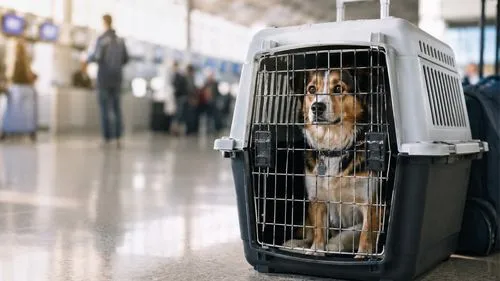
- a safe crate or secured space in the car,
- an absorbent pad or blanket,
- water for longer trips,
- and a calm companion without unnecessary noise.
Some puppies may sleep through the entire journey, others whine, vomit, or are restless. This does not necessarily indicate a problem. It is more of a sign that the change is significant for them and they need time.
When you arrive home, give the puppy a chance to calmly sniff the space. He does not have to run around the entire apartment or garden right away. It is much better to start in a smaller, manageable space where he will not feel overwhelmed.
First hours at home: Let the puppy breathe
New owners often have the tendency to "start right" on the very first day. Showing all the rooms, introducing all the family members, offering a lot of toys, trying the first commands, and taking dozens of photos.
But this can often be too much for the puppy.
The first hours at home should be more about calm than about a schedule.
What to do?
🛏️ Show him the place where he will rest,
💧 offer water,
🏡 take him outside or to a designated potty area,
👀 and let him observe the world at his own pace.
Some puppies are very active upon arriving home and look like they have endless energy. However, often this does not indicate true well-being but overstimulation. Just like small children, they can be "overtired" after a long day and behave even more wildly than would fit their actual needs.
First night with the puppy: What is normal
The first night is often one of the toughest for new owners. The puppy may whine, wake up, seek contact, or seem confused. No wonder. For the first time, he is sleeping without familiar siblings, without known scents, and without the environment he is used to.
It is normal that the first night will not be ideal. It does not mean that the puppy is "adjusting poorly." It mainly means that the change is fresh.
What helps?
- A quiet sleeping place,
- a soft bed or blanket,
- a feeling that someone is nearby,
- and a chance for potty breaks before bedtime.
Many people wonder whether the puppy should sleep alone on the first night or closer to a human. There is no universal answer. If you want him to sleep elsewhere later, it does not mean you cannot make the transition easier for him in the first days. It is more important to focus on long-term direction than to try to "set discipline" on the very first night.
"The first days are not a good time for strict tests of independence."
When the puppy cries, try first to assess what he needs. It could be a need to potty, thirst, cold, insecurity, or simply a need for closeness. The first days are not a good time for strict tests of independence.
First days without overexertion: Why less means more
One of the most common mistakes is the belief that the puppy must "experience everything" right from the start. New owners are afraid of missing something, so within a few days, they want to handle visits, city noise, children, other dogs, traveling by car, training, and solitude.
But a good start does not look like an intense program. It looks like a safe and predictable routine.
In the first days, a puppy will appreciate most:
- predictability,
- a calm rhythm of the day,
- enough sleep,
- short and understandable experiences,
- and space to rest between new stimuli.
Note: An overstimulated puppy may be more bitey, louder, restless, or "naughtier." In reality, he often does not need more activities, but less chaos.
Feeding and drinking: Regularity helps
In the first days, it is good to stick as closely as possible to what the puppy was used to before arriving. A sudden change in food combined with the stress of a new home can easily lead to digestive issues.
What helps:
- Find out in advance what he was fed,
- Do not change the diet drastically in the first days,
- Feed him regularly at the same time,
- and monitor how the puppy eats and drinks.
Some puppies hardly eat on the first day. If they otherwise seem fine, this does not have to be an immediate cause for concern. A change in environment can temporarily affect appetite. It is important that they have access to water and gradually start eating again over a short period.
But be cautious of the opposite extreme: some owners want to soothe the puppy with large amounts of treats, new goodies, and "something extra." This can easily upset his digestion.

Sleep: Puppies need it more than you think
One of the things that often surprises new owners is the amount of sleep. A small puppy sleeps most of the day. And that’s good. Sleep is crucial for development, recovery, and processing new stimuli.
If a puppy gets little rest, he may be:
- overly active,
- more bitey,
- have difficulty concentrating,
- get irritated more easily,
- and generally be more challenging to manage.
Therefore, it is important not to view rest as "doing nothing" but as part of care. A calm sleeping place is just as important as quality food or potty breaks.
Safe space: A puppy does not need the whole world at once
Most people imagine a puppy as a small, cute explorer. And it really is. But that is why it needs a safely set-up environment.
A safe space does not mean limitation "as punishment." It means a place where:
- he cannot hurt himself,
- he does not have access to cables, chemicals, or dangerous items,
- he cannot destroy things that could harm him,
- and where he can calmly settle down.
In the beginning, a smaller, manageable part of the apartment or house usually works. A bed, water, a few safe toys, and a clearly defined space are often better than unrestricted access everywhere.
Find out what traps and pitfalls your house or garden may present for a puppy and how to ensure a truly safe home.

First separation: Don’t start when you have to leave
One common mistake is that in the first days, the puppy is constantly with someone, and then suddenly there is a longer departure. But solitude should not come without preparation.
From the very first days, it is good to start with very short moments of separation. Not long solitude, but small situations where the puppy finds out that a person will leave for a moment and return again.
"From the very first days, it is good to start with very short moments of separation."
This can involve:
- leaving the room for a few seconds,
- briefly closing the bathroom door,
- or a few seconds where the puppy stays in his space and you are not directly next to him.
It is important to start with really small steps. Start before a problem arises.
Find out how long a puppy can stay home alone.
What is normal in the first days and what is not
New owners often do not know what is part of adaptation and what should be addressed already. Here, a simple division is useful.
✅ Often normal
- That the puppy sleeps more or is restless,
- that he whines on the first night,
- that he has less appetite,
- that he needs very frequent potty breaks,
- that he bites more and examines everything with his mouth,
- that he gets startled by new sounds,
- that he seeks closeness to a human.
❗️ Pay attention
- The puppy repeatedly vomits or has severe diarrhea,
- he long refuses food and drink,
- he appears apathetic or very downcast,
- he has noticeable breathing difficulties,
- he panics extremely at every short separation,
- his condition worsens.
The owner's intuition is important. If you feel that "this is no longer just a normal adaptation," it is fine to consult a veterinarian or an experienced expert.
What should you do if your puppy barks after you leave? Read our article Why dogs bark and how to stop it.
Most common mistakes of new owners
The first days with a puppy can be challenging also because a person wants to do everything right. And it is precisely from the desire not to make mistakes that some typical errors arise.
1. Too many stimuli at once
A puppy does not need to experience everything within a few days. It mainly needs a calm and safe start.
2. Lack of sleep
An overtired puppy does not always look tired. On the contrary, he often looks even wilder.
3. Unclear routine
When each day looks completely different, the puppy has a harder time orienting himself. Regularity helps him.
4. Too long solitude right at the start
This is a common issue. In your article about how long a dog can be left alone at home, it is correctly pointed out that age plays a crucial role and puppies have completely different limits than adult dogs. Learn more about separation anxiety in dogs.
5. Overreacting to every whine
Sometimes it is necessary to check the puppy's needs, but at the same time, it helps not to project your own panic onto him.
6. Punishing for accidents or stress
Shouting and punishment usually do not speed anything up. In your article about barking, it is correctly emphasized that shouting and punishment do not work, and in cases of fear or stress, they often worsen the problem.
How to make the first days easier with routine
In the beginning, you do not need to have a perfect schedule down to the minute. But it helps a lot if the day contains repeating elements:
- Waking up,
- potty breaks,
- feeding,
- calm,
- play,
- more rest,
- and evening winding down.
Dogs generally respond well to predictability, and in your article about solitude, routine is described as an important stabilizing element that helps a dog understand when it is time to relax and when they can expect a person to return. This applies even more to a puppy.
When Barkio can help
In the first days, it can be difficult to know what the puppy is doing when you are not with him. Does he calm down after a while? Does he whine? Is he sleeping? Or is he restless from the moment you leave the room?
This is where the Barkio app can make a lot of sense.
You can find out if the puppy really calms down after your departure
Many owners assume that the puppy will fall asleep after a while. But with Barkio, you will see and hear whether he has actually laid down or whether he is still whining, running around, and looking for you.
You can identify when a problem begins
Barkio helps to reveal whether the puppy is restless the moment you leave for another room or only after a few minutes. This is important for correctly setting the first short separations.
You can better assess what is normal adaptation and what is greater stress
A brief whine upon departure may be normal, but prolonged whining, barking, or restlessness indicate that it is necessary to tone down and proceed more slowly.
You can monitor real progress instead of impressions
When training your puppy for solitude, a feeling that "it was probably better" is not enough. With Barkio, you can more easily compare whether he is calmer today, falls asleep faster, or manages to spend a slightly longer time without stress.
You will gain greater assurance in the normal daily routine
In the first days, you can verify how the puppy rests, whether he is awakened by every sound, or whether he is restless every time you step away. This helps to set a calmer routine at home. Thanks to activity records, it is easier to capture changes in rest and behavior.
Conclusion
The first days with a puppy at home are not only cute but also exhausting, chaotic, and full of questions. And that is okay. The beginning does not have to be flawless to be good.
The most important thing you can give the puppy is not a perfect training plan, but safety, calm, and time. Time to get to know the new environment. Time to understand your rhythm of the day. Time to find that he can feel at home.
When you focus on a safe space, rest, regularity, and gentle guidance without overloading in the first days, you will do a lot for the puppy's future. And it is precisely from these unobtrusive foundations that everything else is built later — calm at home, independence, confidence, and trust.