How to reduce excessive barking: why dogs bark and what helps
February 26, 2026

Katka

Barking is a natural way for dogs to communicate. It is their "voice" – sometimes they alert you that something is happening, other times they want contact, release pent-up excitement, or try to chase away something that is uncomfortable for them. The problem starts when a dog barks frequently and seems to bark "at everything." Such barking can be exhausting for you, those around you, and for the dog itself, as it increases tension and over-stimulation over time.
It is important to understand one thing: the goal is not a dog that never barks. The realistic and healthy goal is a dog that can alert you but can then calm down – and importantly, a dog that does not feel the need to bark in situations that are normal and safe for him.
In this article, we will first explain why dogs bark in general, and then focus on barking at home and barking outside. Because the same bark can have completely different reasons – and without proper diagnosis, you will only be trying tricks that do not work.
Not sure what triggers barking at home? Barkio will help you listen to your dog remotely and quickly identify when the barking starts and how long it lasts.

Why dogs bark
Different reasons need different fixes. Barking can often be explained by a simple question: What does the dog gain by barking, or what does it avoid? Once you uncover the answer, you have half the work done.
1. Guarding and territoriality
Dogs bark at sounds in the hallway, at passersby behind a fence, at the doorbell, at "suspicious" objects. They often stand by the window or door and keep watch.
- For the dog, it is functional: a person passes by, the noise stops.
- The dog associates: "I bark = I solve it."
2. Fear and insecurity
Barking can also be a way for a dog to keep its distance. You will recognize it by the fact that the dog may back away, have its tail tucked, a stiff body, and lick its nose.
- The dog is not saying "I am tough."
- It is saying "I do not feel safe."
3. Frustration (I can't get to / I can't escape)
Typical barking happens on a leash, behind a fence, or in a car. The dog wants something (to greet, to run, to "address" a stimulus), but it can't.
- Accumulated energy + restriction = barking.
4. Boredom and excess energy
A dog barks "just like that" at home, barks from the window, reacts to every noise. Often it is a combination of few activities + many stimuli (a window facing a busy street).
5. Attention and learned behavior
Sometimes a dog barks because it has learned that it works:
- "I bark → the person looks at me → speaks → something happens." Even scolding can be rewarding for some dogs because they gain attention.
6. Loneliness and stress (separation anxiety)
Barking after the owner leaves, howling, destroying things, salivating, running around. This is not about training but about stress.
7. Health reasons
If the barking suddenly worsens, if the dog barks at night, or behaves unusually, it is good to rule out pain or health problems.
How to identify the cause of barking and how to react
To avoid guesswork, it greatly helps to observe for a few days when barking occurs. You do not need to keep a complicated diary – it is enough to clarify in your mind (or notes) what exactly is recurring: what stimulus triggers the barking, in what situation it happens, and what follows afterward. This simple "detective work" often reveals in a few days whether it is mainly about guarding, fear, frustration, boredom, or an attempt to gain attention.
For quick orientation, answer three questions:
- Trigger: what starts the barking (window, doorbell, dog outside, loneliness)?
- Context: is the dog at home, on a leash, behind a fence, in a car?
- Outcome: what happens after the barking (the stimulus disappears, you come, the dog receives something)?
Once you know the reason, you can reduce barking by changing the setup and teaching an alternative response. Usually, simply "silencing him" does not work, but rather a combination of reducing the number of situations in which the dog practices barking and showing him what to do instead. When barking due to fear, it is crucial to work with emotions and distance from the stimulus; when barking learned for attention, it is essential to ensure that you do not accidentally reward him.
Stick to these universal rules:
- Yelling and punishments do not work and worsen problems related to fear.
- Teach the dog what to do instead of barking, as an alternative to his behavior.
- Work with emotions, as it is crucial in cases of fear and reactivity.
- Reward silence, not barking.

Barking at home: Window, door, sounds, loneliness
At home, barking often occurs because the dog feels it has to be "on guard," or it demands attention through barking. Here, a combination of adjusting the environment and practicing a calm routine helps a lot.
A major problem at home is that the dog often has the opportunity to bark repeatedly. And what it repeats, it trains. Therefore, it is perfectly fine to start by reducing the number of situations where barking occurs. Not to "sweep it under the rug," but to stop allowing the dog to practice the undesirable pattern daily.
🪟 Dog barks from the window
For many dogs, the window is "cinema." They see dogs, people, cars, hear sounds from the street – and react.
If the dog barks at every movement outside, a simple change of environment often helps: temporarily limit the view (curtain, frosted film), move the dog’s favorite lying spot further from the window, or create a calm zone in another part of the apartment.
Once the barking calms down a bit, the most important part comes: changing the dog's association. Practically, this means that when the dog sees a stimulus outside and hasn't barked yet, it receives a reward. This tells the dog: "Stimulus = good news, you don't have to deal with it." The key is in the timing – reward the second when the dog notices the stimulus but is still comfortable. Gradually, from "guarding" it becomes more like "ah, I already know this."
What helps:
- Temporarily limit the view (curtains, frosted film, moving the couch).
- Teach "come here" / "to your place" and reward calmness.
- Train "I see the stimulus → I get a reward" (counter-conditioning).
This way, the dog learns that there is no need to "deal with" the situation.
🔔 Dog barks at the doorbell and sounds in the hallway
Here, a simple ritual often works. Instead of the dog reacting to the sound by barking, you teach him a specific action that pays off. Typically "to your place" (bed/mat) with a reward for calmness. The ringing then becomes not an alarm, but a signal that the dog goes to its place and waits.
It is important that the training does not begin during an actual visit. First, rehearse the scenario a few times in a relaxed manner: a quiet knock, a doorbell recording on your phone, the sound of an elevator – and immediately guide him to his place and reward him. Only when the dog understands this in a calm state should you add more realistic situations.
🙎♂️ Dog barks to get attention
Attention-seeking barking occurs surprisingly easily: the dog barks, you turn around, speak, come to him. From the dog's perspective, this means "it works." The solution is not to ignore the dog forever but to change the rules so that barking stops being a way to get what the dog wants.
Practically, this works by not reacting to barking (not even with a glance), but the moment the dog stops barking, it immediately gets a chance to succeed – for example, by sitting or calmly coming to you. This way, the dog learns that the best way to gain contact is through calm behavior. For some dogs, barking may briefly worsen in the first days (the dog tries to "push harder"), but if you remain consistent, the breakthrough usually comes quickly.
Note: in the first few days, it may worsen (the dog tries to "push harder"). But if you persist, it often drops quickly.
🥺 Barking alone
If the dog barks only occasionally (e.g., at noises), a combination of limiting triggers often helps. However, if the dog howls after your departure, barks for a long time, destroys things, or appears to be in panic, it may be separation anxiety. This is no longer just about "training," but about working with stress – and professional guidance often helps.
What can help:
- training departures in small doses,
- a safe calm place,
- providing distractions (licking/chewing),
- and importantly, monitoring.
In these cases, it is very helpful to have an overview of what happens when you are not home. The Barkio app allows you to monitor and listen to your dog remotely, so you know when barking starts and how long it lasts. This way, you can set training more precisely and better evaluate progress.
Barking outside: Leash, dogs, people, fence, and frustration
Outside, we most often deal with two main groups:
- reactivity (barking at dogs/people/objects),
- frustration (the dog wants to but cannot).
🦮 Barking at other dogs on a leash
Barking at other dogs is often a mix of frustration, excitement, or fear.
Here, the distance is usually crucial. If you are too close, the dog does not learn – it only reacts. You need to find a distance at which the dog can still perceive you and take rewards. At this distance, retraining begins: the dog sees another dog → it receives a reward for calmness → you continue on. Gradually, the dog’s reaction will soften.
It helps a lot to teach the dog a simple "escape" maneuver. When you see a stimulus that is too challenging, it is better to turn around, cross the street, or make a detour. This does not mean you are losing. It means you are protecting the training area so that the dog does not need to fail repeatedly.
🚲 Barking at people, bikes and strollers
With these stimuli, there is often insecurity or overload behind it. It pays off to work with the principle "stimulus = good news." With insecurity, the key is to change the emotion. Not to "silence," but to "switch" the feeling.
- stimulus in the distance → treat
- stimulus closer → treat
- dog looks → reward
- dog turns away → reward
Goal: "bike = good news," not "bike = alarm."
Note: If the dog barks mainly in busy places, also consider whether it is overloaded with stimuli. Some dogs benefit from temporarily choosing calmer routes and gradually introducing busy sections.
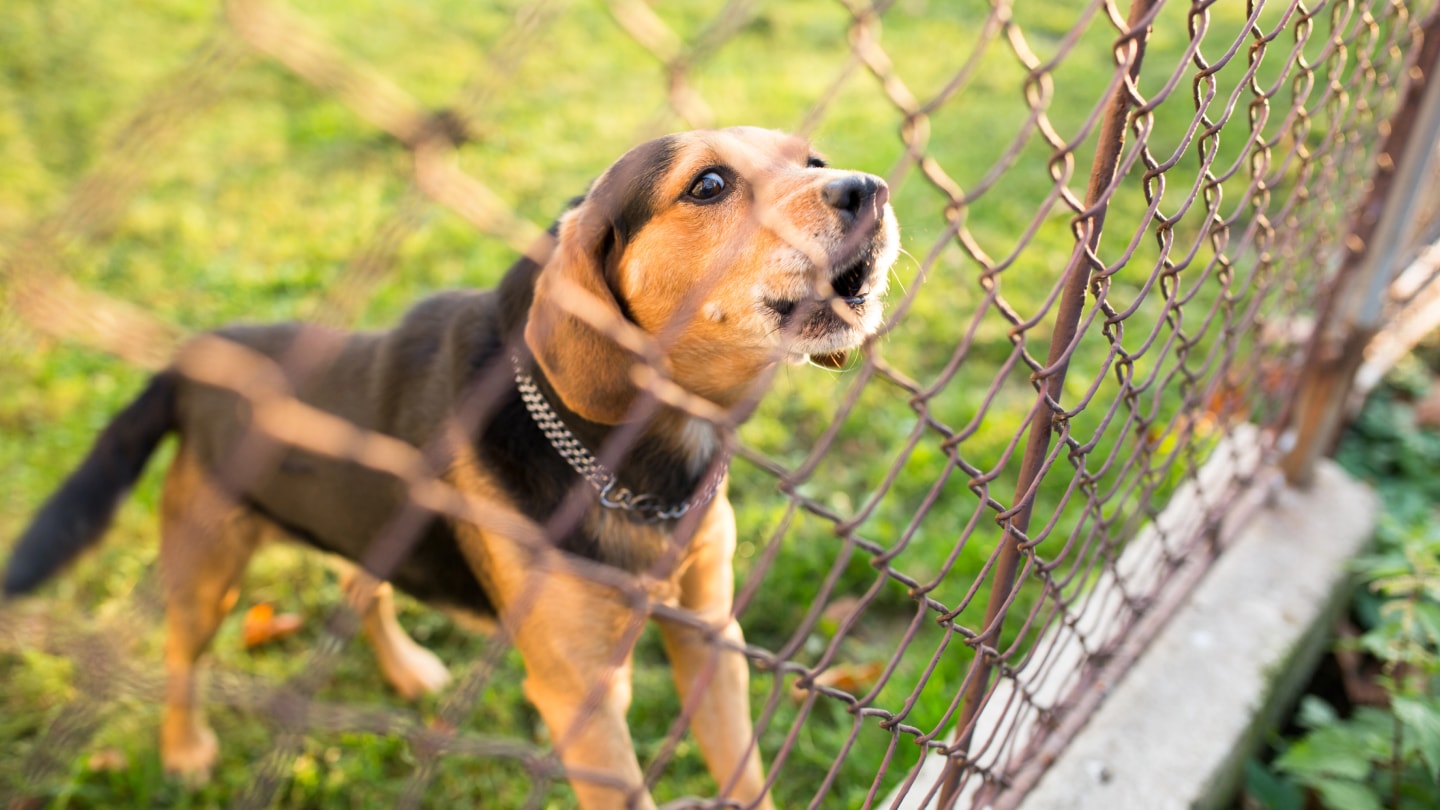
🏡 Barking at the fence / in the yard
Fence barking is often extremely self-reinforcing: the dog barks, the person leaves, and the dog feels it has "chased them away." If possible, it helps to temporarily limit access to the fence unattended, create a visual barrier (screen, tarp, bushes), and teach the dog that it pays off to leave the fence for a reward.
When to use the command "Silence" and when not to
The command "silence" can be useful, but it is not a magic formula. It mainly works with barking that is more habitual or from overflow, and where the dog can still perceive the environment. In barking due to fear or panic, it is usually more effective to work with emotion (distance, counter-conditioning, calm routine), as the dog does not learn in high stress.
If you want to teach "silence," start in a calm environment where you can evoke only a mild reaction (e.g., a quiet knock). Reward the first second of silence and gradually extend the time. It is important that the dog knows exactly what success means: calm moment = reward.
Practical tips that usually help quickly
Before you embark on complex plans, it helps to do a few things that reduce the dog's overall tension. Often, barking is not just "one problem," but a combination of over-excitement, triggers, and habits. Try going through this short checklist:
- Does the dog have daily space to sniff (not just "walk kilometers")?
- Does it have regular short, simple training (2–5 minutes) that gives it a sense of security?
- Does it have opportunities to lick and chew (safe chewing items, licking mat), which naturally calms?
- Does it not spend long hours by the window or at the fence, where it "charges itself"?
Often, just a combination of these points will reduce the number of barking episodes – and training will go much smoother.
Frequently asked questions about barking
1. Should I scold my dog when it barks?
In most cases, it does not help. For some dogs, it is "we bark together"; for fearful dogs, it may worsen the fear. It is better to address the trigger, distance, and offer the dog a clear alternative.
2. Why does my dog bark?
Most often, it is guarding, fear, frustration, boredom, or asking for attention through barking.
3. How do I teach my dog not to bark?
Identify the trigger, reduce the situations when the dog barks, and teach it an alternative with a reward for calmness.
4. How do I teach my dog not to bark when alone at home?
Gradual training of departures, calm activities, and monitoring when barking starts and how long it lasts helps.
5. How do I teach my dog not to bark at people?
Start from a greater distance, reward calmness, and gradually change the dog's emotion towards the stimulus.
6. How do I teach my dog not to bark at other dogs?
Train passing from a distance, reward calmness, and avoid situations in which the dog "explodes" on the leash.
Conclusion
A dog barks because it communicates – and often because it has "worked" in the past or because it does not feel good in a given situation. Once you identify the trigger and the environment in which barking occurs, you have a much better chance of choosing the right strategy. At home, reducing triggers (window, sounds), introducing the "to your place" ritual, and rewarding calmness often helps. Outside, distance, working with emotions, and having a plan on how to manage the situation before the dog starts barking are usually key.
And if you mainly deal with barking when alone or want to be sure when and how barking occurs, it pays off to monitor the dog. Barkio will help you gain an overview and track progress – and this is often the most important advantage in training.