Dog socialization: how to introduce your dog to the world
October 30, 2026

Katka
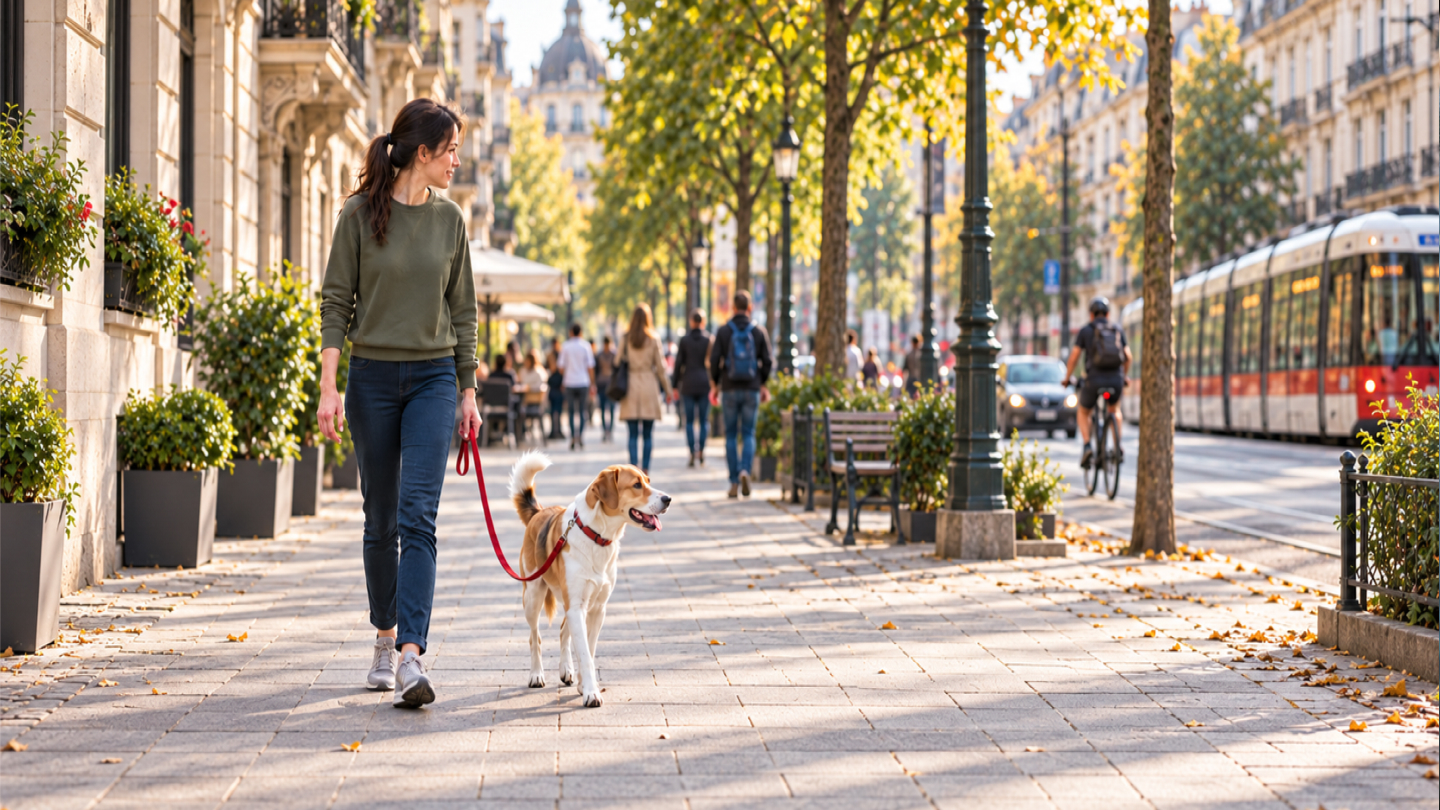
Socialization is not a race to see how many dogs, people, and places your dog can meet in their first few months. It is a gradual process of learning that everyday life is safe and predictable. The goal is not a dog who has to be delighted by every person or be friends with every dog. It is a dog who can notice new things without panicking, move away from them when needed, and rely on you when they feel unsure.
That is why “lots of experiences” at the wrong pace can do more harm than good. A puppy faced with long visits, busy streets, and contact with unfamiliar dogs every day may not be gaining confidence. They may simply be overloaded. Good socialization is brief, guided, and mostly pleasant—or at least neutral.
Barkio can also help while you are teaching your dog to rest independently and cope with the first short periods alone. You can see and hear whether your dog is actually resting after you leave, or whether the step is still too difficult.

What socialization really means
The word socialization can make it sound as though the main task is meeting other dogs. In fact, it is much broader. A dog gradually gains experience with people, animals, sounds, movement, surfaces, traffic, handling, and the environments in which they will live.
This can include:
- calmly watching people of different ages, appearances, and movement styles,
- appropriate contact with well-balanced dogs,
- getting used to the city, visitors, and ordinary household sounds,
- becoming familiar with the car, the vet, grooming, and touch,
- different surfaces, objects, smells, and places,
- learning that short periods of rest without their person are safe.
You do not need to seek out every item on a checklist. What matters is preparing your dog for the things they will genuinely encounter in your shared life. A city dog will need to learn different things from a dog who spends most of their time in the countryside.
Quality matters more than quantity: One calm, well-managed experience helps more than ten interactions that leave a dog stressed.
When to start with a puppy
The most important period for socialization is the first part of a puppy’s life. Experts generally describe it as roughly the first three to four months. That does not mean everything is lost afterwards—dogs learn throughout their lives. But early on, they are usually more sensitive to new experiences and more readily form ideas about what is normal and safe.
You can begin at home. A puppy does not need to walk down a busy street immediately or greet every dog. They can calmly discover household sounds, different surfaces, gentle touch, a carrier, a parked car, or a visit from one calm person.
Always discuss outdoor activity with your vet in light of local risks and your puppy’s vaccination plan. Even before vaccinations are complete, however, you can safely introduce a puppy to the world from your arms, a carrier, a car, your own clean garden, or through contact with healthy, vaccinated dogs you know.
What a puppy can gradually get to know
- people wearing hats, carrying umbrellas or backpacks, or using walking sticks,
- children—always under active adult supervision,
- calm, socially skilled adult dogs,
- the sounds of traffic, a vacuum cleaner, an elevator, doors, and household appliances,
- different surfaces: grass, paving, wood, carpet, gravel, or metal grating,
- short car journeys and safe restraint,
- gentle handling of paws, ears, mouth, and coat,
- short periods alone in a safe space.
These are not tasks you need to tick off in a single week. If your puppy finds something easy, you can repeat that experience on another day. If they are afraid, increase the distance, shorten the situation, or leave it for another time.
How to recognize the right pace
A dog who is coping with a situation can look around, sniff, take a treat, respond to you, and relax again after a short time. They do not have to be excited; it is enough that they are not distressed.
Warning signs that it is too much may include:
- turning the head or whole body away,
- freezing, a tucked tail, a crouched posture, or trying to leave,
- lip licking, yawning when not tired, or faster breathing,
- refusing a treat they would normally take,
- barking, lunging, frantic jumping, or being unable to settle.
One signal alone does not always prove anything. Look at your dog’s whole body, the situation, and what has changed from their usual behaviour. You can learn more about subtle signals in Dog body language: stress, fear, uncertainty, and wellbeing.
When your dog feels unsure, make it easier: More distance, a shorter duration, or a quieter place are not a step backwards. They are the conditions that help your dog feel safe again.
A simple process: distance, a positive experience, and a break
Introduce something new in a way that lets your dog observe it first from a safe distance. Reward calm behaviour with something pleasant—a treat, a toy, a chance to sniff, or simply space to leave. Then take a break.
Only move closer or make things more difficult once your dog repeatedly remains relaxed. In practice, it might look like this:
- Your dog sees a cyclist from a distance and stays calm.
- They look at the cyclist, receive a treat, or return to sniffing.
- The cyclist passes and you move to a quieter place.
- During the next session, you begin a little closer—only if the previous step was easy.
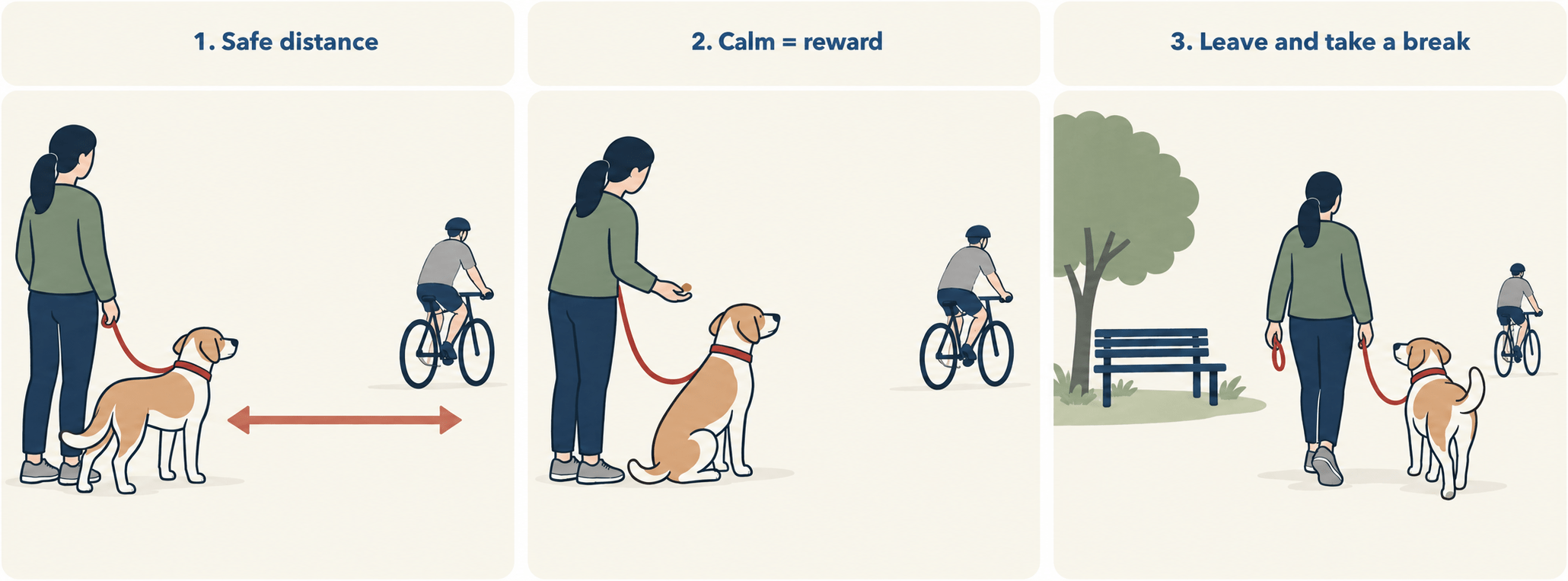 This principle works with dogs, people, traffic, vacuum cleaners, and veterinary handling. There is no need to persuade a dog to move closer. Having a choice increases their sense of safety.
Introducing people and children
Making a dog allow every person to pet them is not socialization. Strangers can ignore your dog, stand sideways, and let them decide whether to approach. If your dog does come over, petting the side of the chest or body is usually better than reaching over the head. If they move away, the interaction ends.
The rules are even stricter around children. A dog should not be hugged, dragged around, disturbed in their bed, or expected to tolerate hands on their face, ears, or tail. Even a kind child can be fast, noisy, and unpredictable from a dog’s perspective.
A good experience with a child often looks uneventful: the child sits calmly some distance away, an adult keeps the dog at a safe distance, and the dog is rewarded for watching the child calmly. Direct contact is not required.
Introducing other dogs: not every dog has to be a friend
Many dogs get along with only selected individuals, and that is perfectly fine. The aim is not for your dog to greet every dog on a walk or spend time in a group that does not suit them. For a dog who is learning to respond calmly to other dogs, simply seeing them at a safe distance and staying relaxed is already a success.
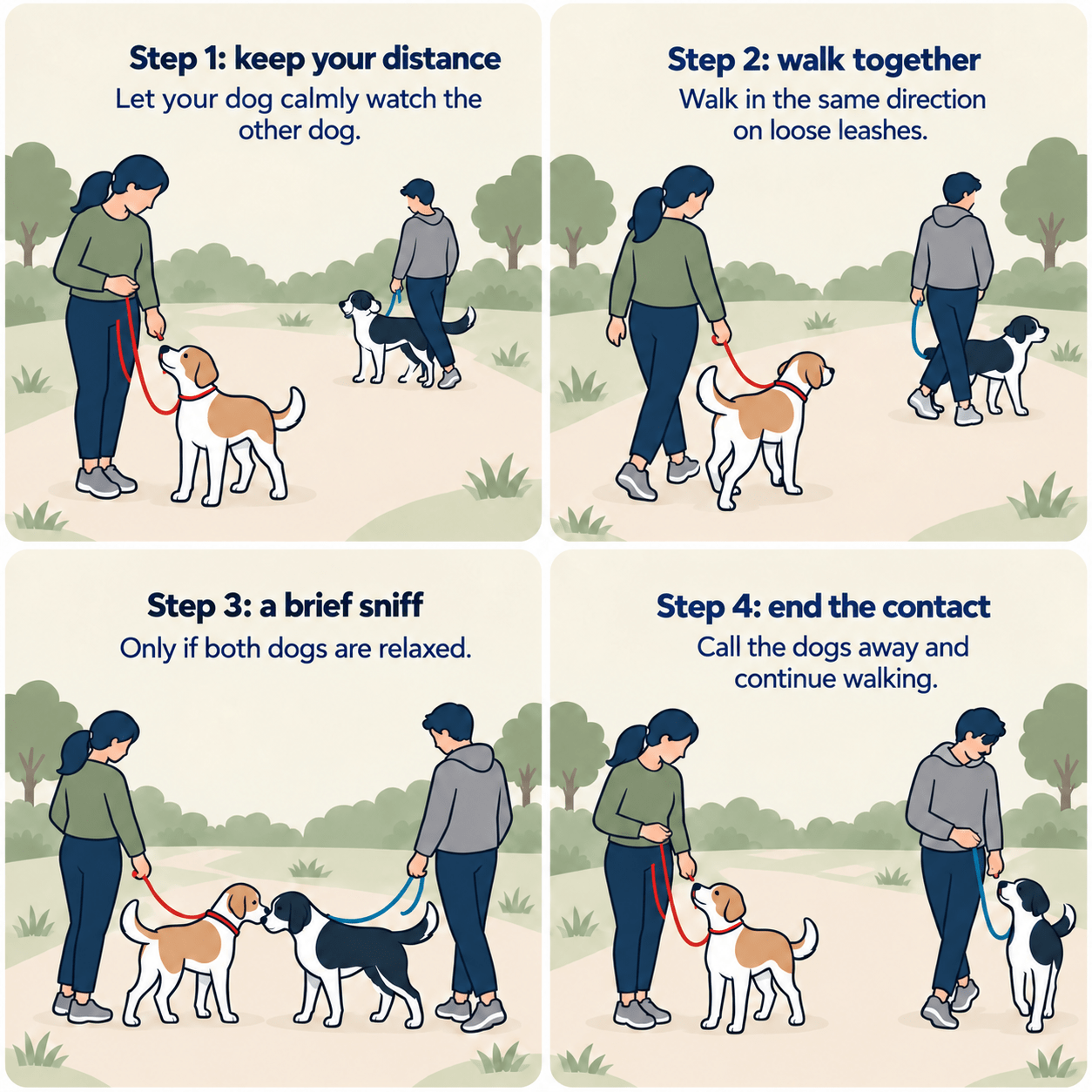
Start with one familiar, well-balanced dog and two people in an open area with plenty of space. Keep enough distance for your dog to notice the other dog while still having a soft body, being able to look at you, or take a treat. Reward your dog beside you for calmly looking at the other dog and for choosing to turn their attention back to you. If they freeze, stop taking treats, try to leave, or become too aroused, increase the distance again.
Only after repeated calm experiences should you try walking in parallel at a distance. Both dogs walk in the same direction, each with their own person, on loose leashes. Move closer only when both remain relaxed. Give treats to each dog beside their own person—not between the dogs or during contact.
A brief sniff is not a required step. Offer it only when both dogs are calm, choose to engage, and can move away freely afterwards. Let them sniff for only a few seconds, then each person gently calls their dog away and you continue walking. A walk without a greeting is a complete—and often safer—socialization experience.
Avoid situations with many unfamiliar dogs, little space, and high excitement. A dog park is not an essential part of socialization and is not a suitable environment for every dog.
Getting used to the vet, handling, and grooming
Body care can be challenging for many dogs if they only encounter it when it becomes necessary. At home, practise very brief, gentle touches: touch a paw, look at an ear, lift a lip, or place a brush against the coat. Follow immediately with a reward and finish.
Your dog learns that touch is not a trap. If they pull a paw away or turn their head aside, do not insist on finishing the task. Make the step easier and practise another time. Short “happy visits” to the veterinary clinic can also help: you simply stop by, your dog receives a treat, and then leaves again—if the clinic allows it.
Socializing an adult or adopted dog
Adult dogs can learn new things. What usually does not help is the strategy of “throw them in at the deep end so they get used to it.” If you do not know their history, start conservatively: safe distance, short experiences, an escape option, and plenty of rest in between.
For a dog already reacting with fear, lunging, or panic, it is wise not to wait for the problem to become more established. A vet can rule out pain or other medical causes and recommend a qualified trainer or behaviour professional who works without force or punishment.
What not to do with an adult dog
- do not make them accept touch from unfamiliar people,
- do not pull them closer to what frightens them,
- do not put them into a group of unfamiliar dogs without preparation,
- do not punish growling, moving away, or other warning signals,
- do not raise expectations just because they “tried it once”.
Being alone is a skill too
Your dog needs to learn not only how to meet the world, but also how to rest safely without your constant presence. Begin with very short, easy moments in a safe space: your dog chews a toy or rests while you step into the next room for a moment. Return before they start to feel unsure.
Increase the duration only when your dog handles the previous step calmly. Pacing, barking, whining, or destroying things are not signs of defiance; they may mean the step is too big. Barkio can give you feedback even when you are not at the door and cannot see your dog.
Common socialization mistakes
Too many new things in one day
A visit, a tram ride, a shop, a dog park, and a restaurant in the evening can be far too much for a puppy or an adult dog. After a demanding experience, they need time to process and rest.
Forcing contact
“They have to get used to it” often means a dog loses the ability to choose. When they cannot leave, discomfort can turn into panic or a defensive reaction.
Mistaking high arousal for happiness
Jumping, frantic tail wagging, barking, or gulping down treats do not necessarily mean a dog loves the situation. Watch whether their body is soft, whether they can disengage, and whether they settle afterwards.
Waiting for a problem to “go away with age”
Some worries are more likely to become established without support. The sooner you change the pace, environment, or way you work, the easier it is for your dog to gain a better experience.
A practical plan for the first weeks
Every dog has their own pace, but this framework is a safe starting point:
- Every day: plenty of sleep, brief play, sniffing, and simple positive training at home.
- Several times a week: one new, short, easy experience—for example, hearing a bus from a distance or meeting a calm person.
- Ongoing: gentle handling, a few seconds of independent rest, and short car journeys.
- After a more demanding day: no additional “socialization programme”; just an ordinary routine and calm.
Do not measure success by how many situations your dog has completed. Ask instead: could they be curious? Could they move away? Did they settle after the experience? Those are much better signs that they are learning in the right direction.
Frequently asked questions
Does a puppy have to meet every dog?
No. A safe experience with a few suitable, socially skilled dogs matters more than quantity. A puppy can also learn by calmly watching other dogs from a distance.
Is it too late to socialize an adult dog?
No. With an adult dog, begin more slowly, with more distance and no pressure. If they show intense fear or reactivity, help from a qualified professional is worthwhile.
Does a dog need to go to a dog park to socialize?
Not necessarily. A group of unfamiliar dogs in a limited space can be demanding for many dogs. A parallel walk with one suitable dog, or calmly passing dogs at a distance your dog can manage, is often safer.
What if my dog refuses treats?
It often means they are too aroused or the trigger is too close. Increase the distance, make the situation easier, or move somewhere quieter. Do not force your dog to take a treat.
In conclusion: safety before performance
A well-socialized dog is not one who handles everything without emotion. It is a dog with enough positive experiences, who can turn to you, move away from an uncomfortable situation, and gradually build confidence in the world around them.
When you go slowly, read your dog’s signals, and give them a choice, you create a stronger foundation than any rapid “toughening up” ever could. Socialization is not a one-time puppy project. It is sensitive, ongoing learning throughout your life together.