Dog body language: Stress, fear, uncertainty
September 17, 2026

Katka
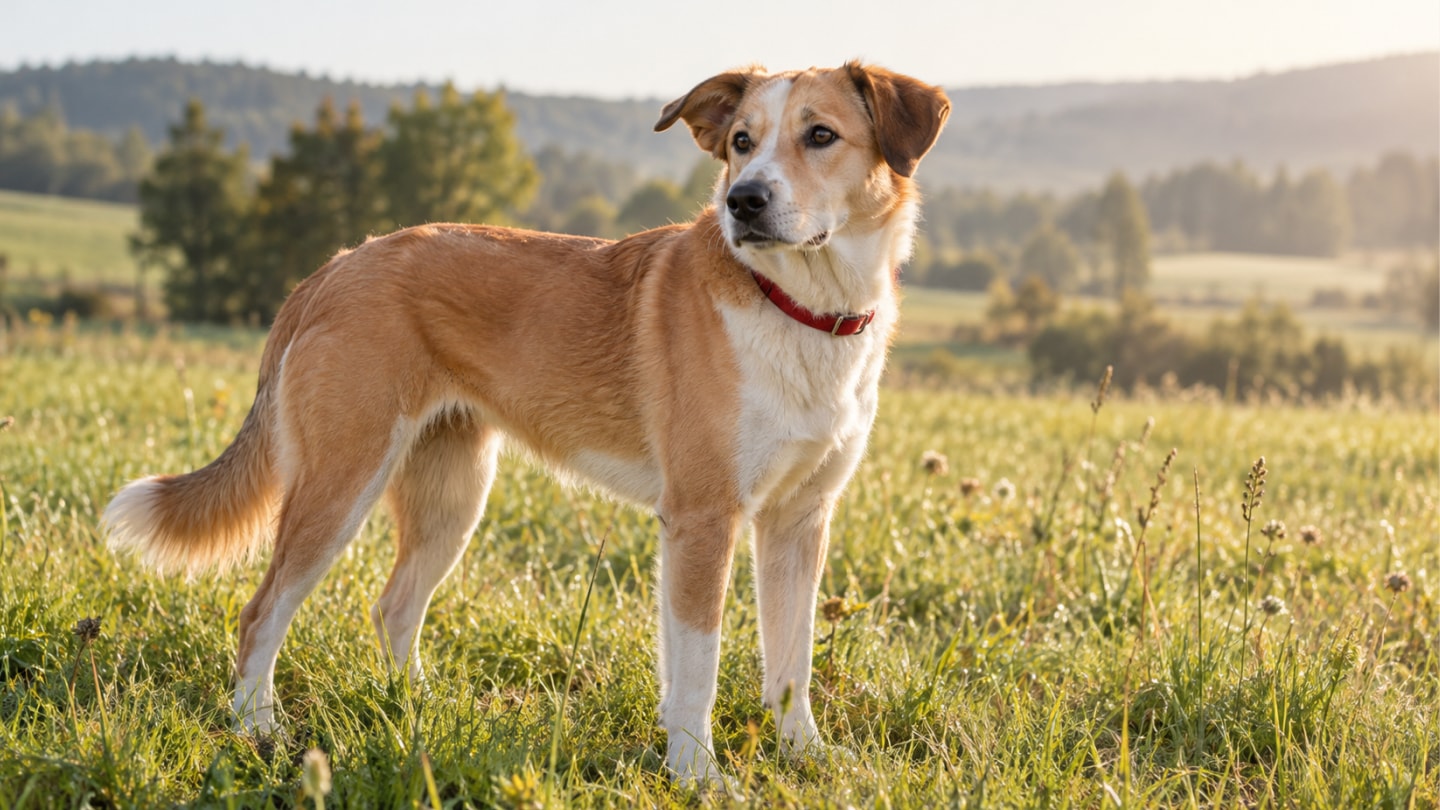
A dog cannot tell you that visitors make them nervous, that they do not want any more petting, or that something hurts. Yet they communicate almost constantly—through posture, gaze, the position of their ears and tail, movement, breathing, and the way they use space.
Some signals are obvious and easy to spot. Growling, running away, or hiding are hard to miss. Much more often, though, a dog starts subtly: they turn their head away, lick their nose, freeze for a moment, or try to leave. When you understand these small signals, you can respond before discomfort turns into panic, barking, or defensive behaviour.
It is useful to watch your dog's body language even when you are not at home. With Barkio, you can see whether your dog relaxes after you leave, paces around the room, watches the door, or cannot settle. That gives you context you could easily miss when you return.

Why it is important to understand dog body language
Dog communication is not a dictionary in which every movement has one fixed meaning. The same gesture can mean different things in different situations. A dog may yawn because they have just woken up, but also because they are stressed. They may lift a paw while anticipating play, concentrating on a scent, or feeling unsure.
That is why it is important to watch three things at once:
- the whole body, not just the tail or ears;
- the situation in which the behaviour appears;
- any change from how your dog normally behaves.
If a dog licks their lips after eating, they are probably just cleaning up. But if they lick their lips while an unfamiliar person leans over them, turn their head away, and pin their ears back, they are probably saying that the contact feels uncomfortable.
Look at the whole picture: one signal on its own is usually not enough. The most reliable understanding comes from the combination of posture, movement, facial expression, and the specific situation.
What a relaxed and content dog looks like
Before focusing on stress and fear, it helps to know the baseline. A relaxed dog does not look rigid. Their movements are fluid, their muscles are soft, and their weight is distributed naturally.
You may often notice that:
- their eyes look soft and they are not giving a hard stare;
- their mouth is closed without tension or slightly open;
- their ears sit naturally for their breed;
- their tail is carried naturally and moves freely;
- their body is neither crouched nor stretched high with tension;
- they can stretch out, lie on their side, or fall asleep peacefully;
- they respond to their surroundings but do not need to monitor everything constantly.
During play, movement can of course be much livelier. A typical play bow brings the front of the body down while the hindquarters stay up; the movement is springy and exaggerated. A happy dog may also wag their whole rear end, run around, or bring you a toy.
Even here, do not judge by one detail alone. A dog that wags their tail is not automatically friendly and relaxed.
What tail wagging really means
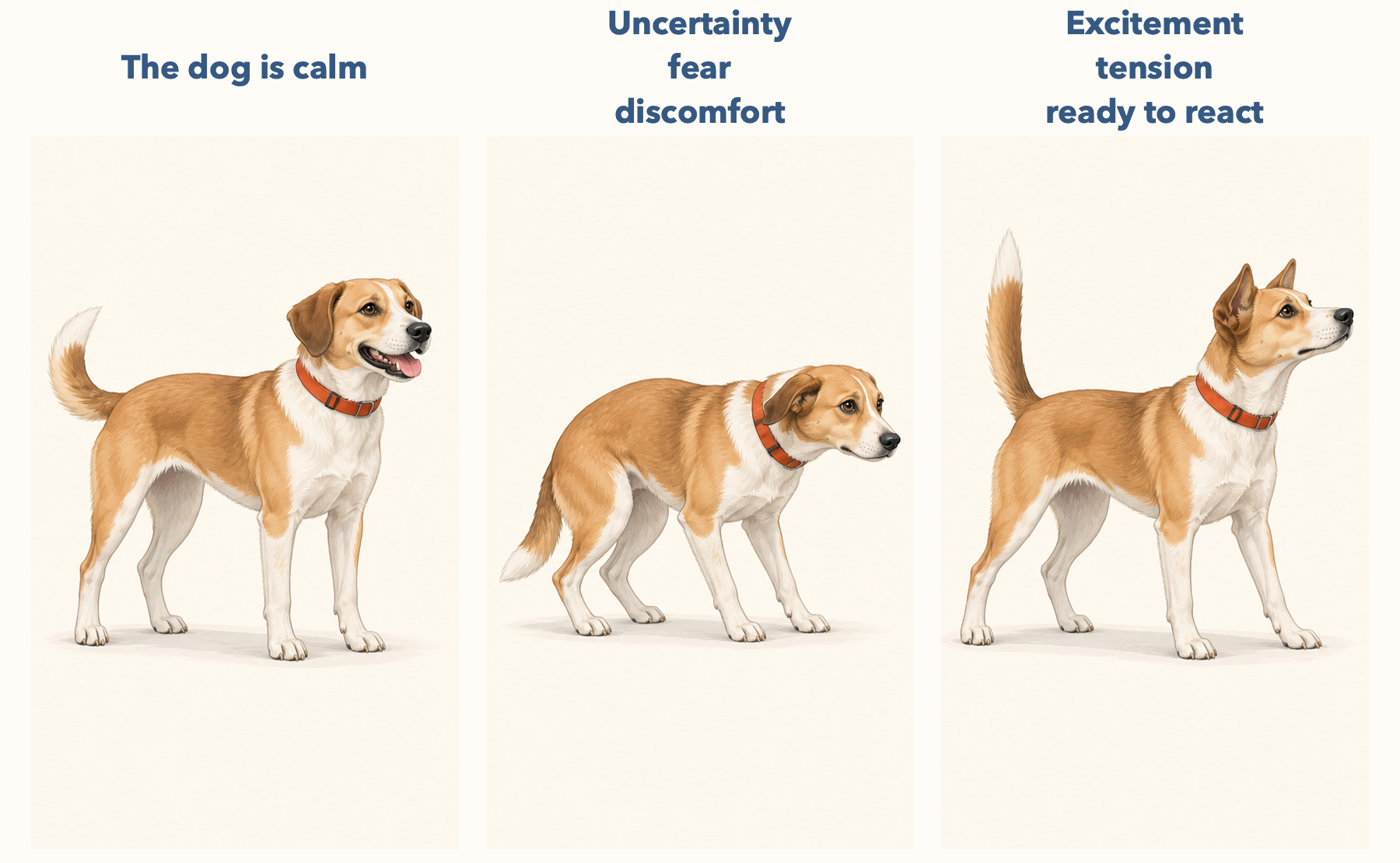
A wagging tail is one of the most commonly misread signals. Wagging generally shows that a dog is experiencing increased arousal. The rest of the body tells you whether that arousal is joy, uncertainty, tension, or a warning.
Loose, whole-body wagging
A broad, relaxed tail movement that makes the hips sway often accompanies a happy greeting or pleasant anticipation. The body is soft, the expression open, and the dog moves without stiffness.
A low or tucked tail
A low-carried tail can suggest uncertainty. A tail tucked between the legs usually accompanies fear or strong discomfort, especially when the dog is also crouching and trying to make themselves smaller.
A high, stiff tail
A tail held high with short, rigid movements can mean intense arousal, tension, or readiness to react. If the whole body is stiff and the dog is staring, increase distance and avoid escalating the situation.
Wagging does not always mean happiness. Pay particular attention to whether the movement is loose or stiff, how high the dog carries their tail, and what the rest of their body is doing at the same time.
What a dog's ears can tell you
Ears react quickly to sounds, attention, and emotions. But you need to interpret them for the individual dog. The upright ears of a German Shepherd, the long ears of a Cocker Spaniel, and the folded ears of a Greyhound look very different at rest.
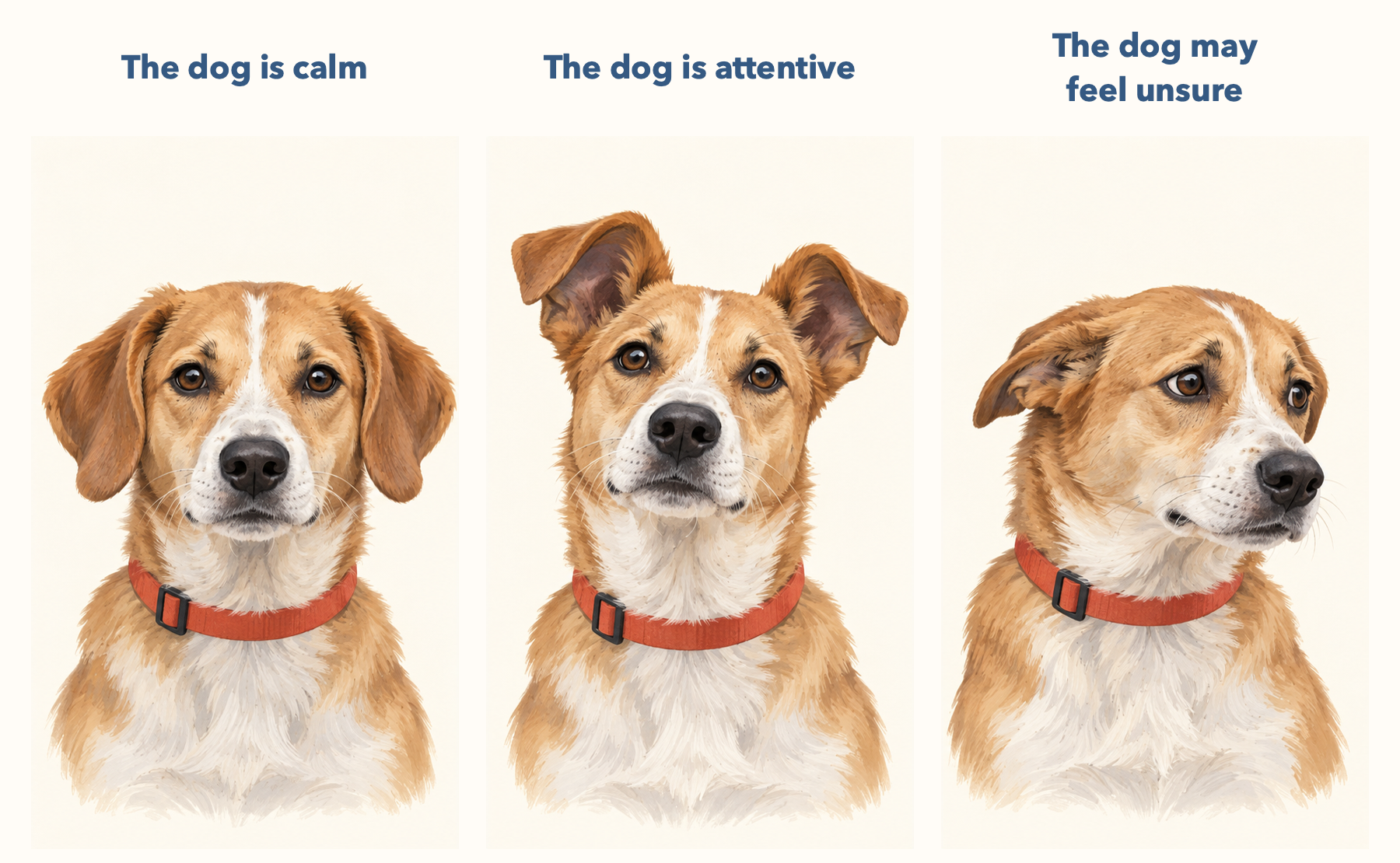 In general:
- naturally held, relaxed ears tend to be a sign of calm;
- ears turned forward show increased attention or interest;
- ears pulled back can accompany uncertainty, an attempt to reduce conflict, or fear;
- ears pinned tightly back together with a crouched body often indicate pronounced discomfort.
Ears alone are not enough, though. A dog may also pull their ears back during a joyful greeting. In that case, the rest of the body is soft, the dog approaches, and their whole body wags freely. A frightened dog is more likely to move cautiously, keep their body low, and try to retreat.
Dog eyes and gaze
Eyes can reveal tension before a dog starts protesting loudly.
Soft eyes
Relaxed eyes, natural blinking, and a calm expression usually go with comfort. The dog does not need to monitor their surroundings constantly and can look away naturally.
Turning the head or gaze away
When a dog looks to the side, they are not necessarily ignoring you or being disobedient. They are often trying to reduce tension and saying that direct contact does not feel comfortable. Notice this, for example, during hugging, photos, introductions to children, or handling.
Visible sclera, also called whale eye
If a dog turns their head away but still watches what is worrying them, more of the white of the eye may become visible. This expression is called whale eye. It often indicates stress, anxiety, or a feeling of threat.
A hard, fixed stare
A rigid stare without natural blinking, together with a tense mouth and body, is a warning signal. Do not try to overpower a dog with prolonged eye contact. Give them space and remove the source of conflict if it is safe to do so.
Mouth, yawning, and lip licking
A relaxed dog's mouth is soft and sometimes slightly open. Suddenly closing the mouth or tightening the lips can be one of the first signs that their emotional state has changed.
Subtle signs of discomfort include:
- a quick lick of the nose or lips when food is not involved;
- yawning when the dog is not tired;
- fast or shallow breathing without heat or physical exertion;
- drooling that is unusual for the dog;
- a firmly closed mouth and tense mouth corners.
Showing teeth, growling, or snapping are clearer requests for distance. Do not punish growling. It is important information that the dog is not coping with the situation. Punishing the warning may suppress the sound, but not the fear or discomfort behind it.
Whole-body posture and movement
Overall posture often says more than individual body parts.
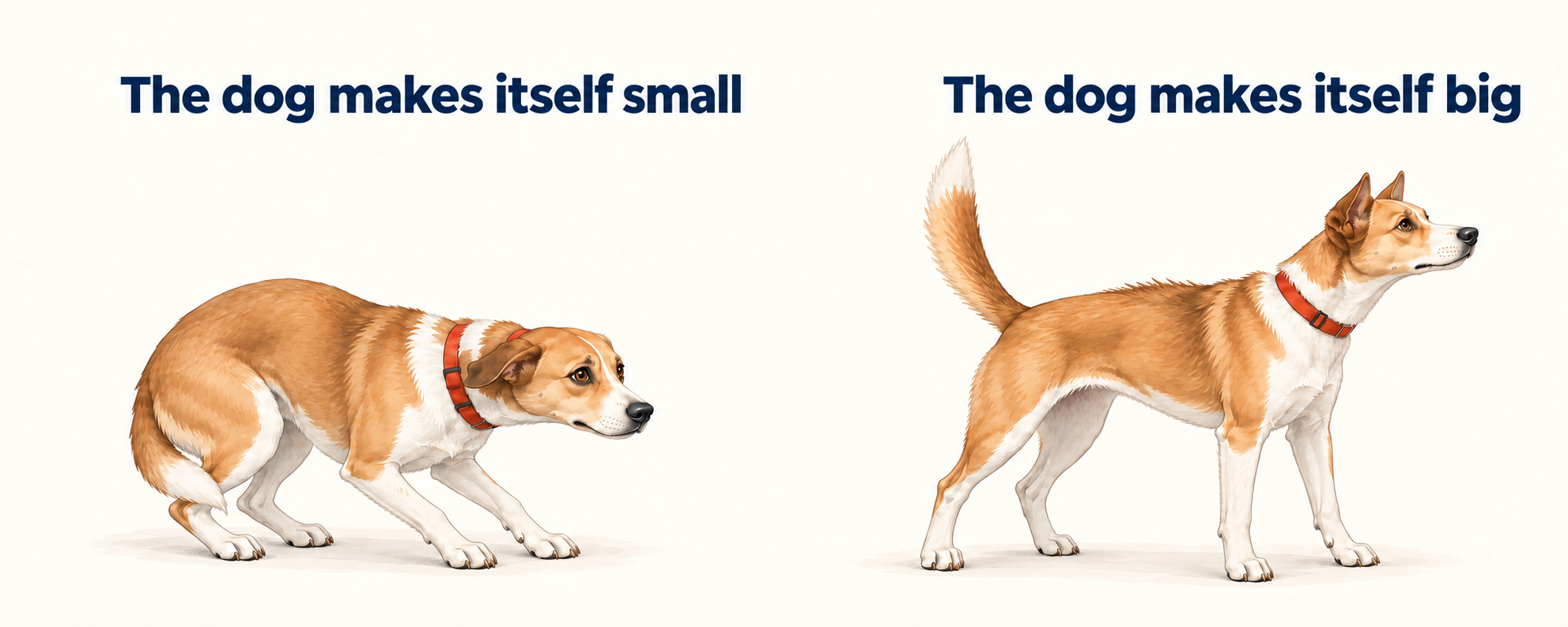
The dog is trying to make themselves smaller
Crouched legs, a low head, a tucked tail, and weight shifted backwards show that a dog does not feel safe. They may be trying to leave, hide, or create more distance.
The dog is trying to make themselves larger
An upright body, weight forward, stiff legs, a high head, and sometimes raised hackles show high arousal or tension. This does not automatically mean an attack, but the situation calls for caution.
The dog suddenly freezes
A brief freeze is easy to overlook. Yet it can be one of the most important warnings. If a dog suddenly stops breathing freely and stiffens their whole body when touched, near their food bowl, while meeting another dog, or around a child, stop the interaction and give them space.
The dog paces or cannot lie down
Repeatedly walking the same route, checking the door, getting up and lying down, or constantly changing places can indicate restlessness. Context matters: the dog may be waiting for a walk, need to go outside, be in pain, or be stressed by being alone.
12 common signs of stress and uncertainty
Subtle signals can appear on their own, but they often occur together. Pay close attention to:
- turning the head or whole body away
- quick nose and lip licking
- yawning when not tired
- ears pulled back
- visible eye whites
- sudden freezing
- a tucked or low-carried tail
- a crouched posture and weight shifted backwards
- lifting a front paw in an uncertain situation
- trembling, drooling, or rapid breathing for no obvious reason
- refusing treats, play, or contact
- pacing, hiding, or attempts to leave
No dog has to show the whole list. Every dog has their own way of communicating, and some signals last only a fraction of a second. It is worth learning what is typical for your own dog.
When your dog needs space
Dog signals often increase gradually. A dog may first turn their head away, lick their nose, or try to leave. If that does not help, they may freeze, growl, show teeth, snap, or bite. Not every dog goes through all of these stages, and not always in the same order.
If you notice that your dog is unsure:
- stop what you are doing;
- let them leave;
- increase the distance from the trigger;
- ask other people not to touch them or lean over them;
- do not try to comfort them at all costs with touch;
- wait until their body relaxes again.
Adult supervision is essential around children. A child may not recognise head turning, freezing, or lip licking as a request for calm. At the same time, a dog should not be forced to tolerate hugs, climbing into their bed, or having toys taken away.
The option to leave helps: a dog who has somewhere to retreat and whose subtle signals are respected has less reason to move on to stronger warnings.
Joy, excitement, and overstimulation
Not every burst of high activity means stress. A dog may run around, bark, or jump because they are happy. But joyful excitement can turn into overstimulation and frustration, when the dog can no longer respond well.
With healthy enthusiasm, the body remains springy, the dog can disengage from the activity, and they can calm down after a while. When overstimulated, a dog may:
- jump up and grab at hands or clothing;
- bark without stopping;
- run wildly and bump into things;
- stop responding to familiar cues;
- be unable to lie down even after the activity ends.
In that moment, more intense play usually does not help. It is better to reduce stimulation, move to a quieter environment, and give the dog time to rest.
How to read dog body language when they are home alone
When your dog is alone, you cannot judge their behaviour only by what you find when you come back. A chewed cushion does not tell you whether they were bored after three hours or became stressed one minute after the door closed. The timing is crucial.
Signs that your dog is probably resting
- After you leave, they find a place and lie down comfortably.
- They change positions and can sleep.
- They respond briefly to ordinary sounds, then settle again.
- Their body is not rigid and they do not watch the door constantly.
Signs that your dog may be uncomfortable
- They pace for a long time between doors and windows.
- They repeatedly get up and cannot fall asleep.
- They breathe quickly even though it is not hot.
- They whine, bark, or howl.
- They scratch at the door and look for a way out.
- They ignore favourite food or toys.
- They destroy things, especially near the exit.
With Barkio, you can watch your dog live while they are alone and use recordings to return to the moment their behaviour changed. This makes it easier to identify triggers, the length of their restlessness, and whether the situation improves during training.
If your dog barks regularly after you leave, read Why do dogs bark and how can you stop it. If they damage things at home, article Why does my dog chew furniture and destroy things can help you tell boredom from stress.
Common mistakes when reading dog behaviour
“If they wag their tail, they are friendly.”
Wagging shows arousal, not automatic happiness. The height and stiffness of the tail, as well as the rest of the body, are what matter.
“They are showing their belly because they want petting.”
Sometimes they are. A relaxed dog may offer their belly and seek contact. But a dog lying rigidly with their tail between their legs, ears back, and head turned away may instead be asking for the pressure to stop.
“They yawn because they are tired.”
Yawning can be related to sleep, but in a demanding situation it can also be a sign of stress. Again, the context and other signals are what matter.
“They know they did something wrong.”
The so-called guilty look is often not an admission of guilt. Pulled-back ears, looking away, crouching, and lip licking may be a response to an angry voice, posture, or an expected conflict.
“They are growling to see who is boss.”
Growling is primarily communication. The dog is saying they do not feel safe or want more distance. Punishing the warning without addressing the cause can make the situation worse.
How to learn to read your own dog
Your own dog is the best textbook. Start in situations where they feel good and learn what their normal relaxed expression looks like. Then watch for small changes.
A simple approach can help:
- Describe only what you see, without assumptions. For example: “The dog closed their mouth, turned their head away, and lifted a paw.”
- Notice what happened immediately before. Did a child come closer? Was there a loud sound? Were you about to leave?
- Change one thing. Increase the distance, end the touch, or make the environment quieter.
- Watch whether the body softens again and the dog begins to behave more naturally.
- Make a note of recurring triggers and the first signals.
A short video can capture a subtle gesture you did not notice at the time. Only record ordinary situations, though—never deliberately expose a dog to stress just to get an example.
When a change in body language may mean pain or illness
Behaviour and health are closely connected. A dog who suddenly starts avoiding touch, growling when lifted, hiding, becoming unusually restless, or becoming very passive may be in pain or have another health problem.
Contact a veterinarian especially when:
- the change is sudden compared with the dog's usual behaviour;
- the dog reacts sensitively to touch in one particular area;
- limping, vomiting, diarrhoea, loss of appetite, or breathing difficulties appear as well;
- they cannot rest or their condition worsens;
- pronounced fear or defensive behaviour has no clear cause.
First, it is important to rule out a medical problem. If the dog is physically well but fear, anxiety, or reactivity persist, contact a qualified trainer or behaviourist who works sensitively and without punishment.
Frequently asked questions
How do I know whether my dog is stressed?
Common signs include freezing, turning the head away, lip licking, yawning, ears pulled back, visible eye whites, a low tail, trembling, rapid breathing, and attempts to leave. Always look at several signs and the specific situation.
Does a wagging tail mean that my dog is happy?
Not always. Wagging means that a dog is experiencing increased arousal. Broad, loose wagging with a soft body often accompanies happiness, while a high, rigid tail with short movements can signal tension.
Why does my dog lick their nose when there is no food?
A brief nose lick can be a subtle sign of uncertainty or stress. If it appears when someone approaches, touches the dog, or in a new situation alongside other signs of discomfort, give your dog more space.
What does it mean when I can see the whites of my dog's eyes?
Whale eye often occurs when a dog turns their head away but still watches something that worries them. It is a reason to stop applying pressure and let them leave.
Is it right to punish a dog for growling?
No. Growling is a warning that the situation feels uncomfortable to the dog. You need to increase distance safely and address the cause, not simply silence the signal.
How can I tell whether my dog truly rests when home alone?
A relaxed dog lies down, changes comfortable positions, sleeps, and settles again after an ordinary interruption. Long periods of pacing, watching the door, rapid breathing, or repeatedly getting up may indicate discomfort. Barkio can help you observe this pattern remotely.
Expert sources
- Dogs Trust: How to understand your dog's body language
- Dogs Trust: Helping dogs cope with fear and big emotions
- RSPCA: Understanding a dog's body language
- American Kennel Club: Understanding dog body language
Conclusion
Dog body language is not about memorising one list of gestures. It is about observing the whole dog in a specific situation and respecting their subtle signals before they need to communicate more strongly. A relaxed body, soft eyes, and natural movement usually show comfort. Freezing, turning away, lip licking, a tucked tail, or attempts to leave, on the other hand, say that the dog needs a change.
The better you know your dog's normal behaviour, the sooner you will notice when something changes. Whether you are together at home, visiting someone, out for a walk, or watching your dog through Barkio while they are alone, the most important thing is not to overlook their signals. A dog we listen to early does not need to make their discomfort louder.